Founding a company in a country that isn't yours
I signed the company's deed of incorporation on a Tuesday morning, at a notary's office in Madrid, with two people I had known for a little over a year. I remember sitting there, listening to the notary read out clauses in a Spanish that is mine but not entirely, thinking two things at the same time.
Translated automatically from Spanish.
I signed the company's deed of incorporation on a Tuesday morning, at a notary's office in Madrid, with two people I had known for a little over a year.
I remember sitting there, listening to the notary read out clauses in a Spanish that is mine but not entirely, thinking two things at the same time. The first: this is what I wanted for years. The second, stronger: I have no idea how my partners are going to react when problems come up between us.
Nobody warns you that those two things coexist. That you can be convinced and have real doubts in the same chair.
Trusting people you've known for a short time
This is the part that cost me the most, and not because of them. Because of me.
I come from a place where trust is built over years. With barbecues, with jobs worked together, with having seen someone at a bad moment. Here I had none of that. I had a year and a bit of having worked together on real projects, with real deadlines and clients who got genuinely angry. And at some point I realized that was better information than fifteen years of friendship.
Because you saw a friend at a birthday party. You saw a business partner when production crashed on a Friday at seven in the evening. You know how they write when they're tired, whether they let you know when they're running late, whether they cover up a mistake or tell you about it. That's not given by seniority, it's given by exposure.
Even so, the fear didn't go away. I still think trust is a bet and not a calculation, and that the betting part can't be eliminated no matter how many good signals you gather. What I did was different: instead of trying to be sure, I decided I was willing to lose if I was wrong. That's a different question. And that one I could answer.
The country squeezes
I'm going to be honest because this is a personal blog and not an entrepreneurs' brochure: Spain isn't designed for you to start a business. It's designed for you to work as an employee and not cause trouble.
The whole system pushes in the same direction. The self-employed contribution you pay whether you invoice or not. The VAT you advance and get back whenever they feel like it. The accountant you absolutely need because the quarterly tax forms are a language of their own. The taxes that, when you add everything up, make you calculate how much is left of each euro, and give you a number you'd rather not have calculated.
And there's something worse than the numbers, which is the message. Every bit of paperwork tells you quietly: go back to payroll, man. You were fine there. Payroll, two extra paychecks a year, and at six in the evening the problem belongs to someone else.
There are days when that message gets through. I won't say it doesn't.
What I've learned is to separate the anger from the analysis. The anger is legitimate and useless. The analysis is that this is the price of the ticket, and you either pay it or you don't play. It's not fair. It's just how it is. And spending two years complaining about how unfair it is would have been two years of doing nothing, which costs a lot more.
Starting without a network
This was the most real fear of the three, and the one people talk about the least.
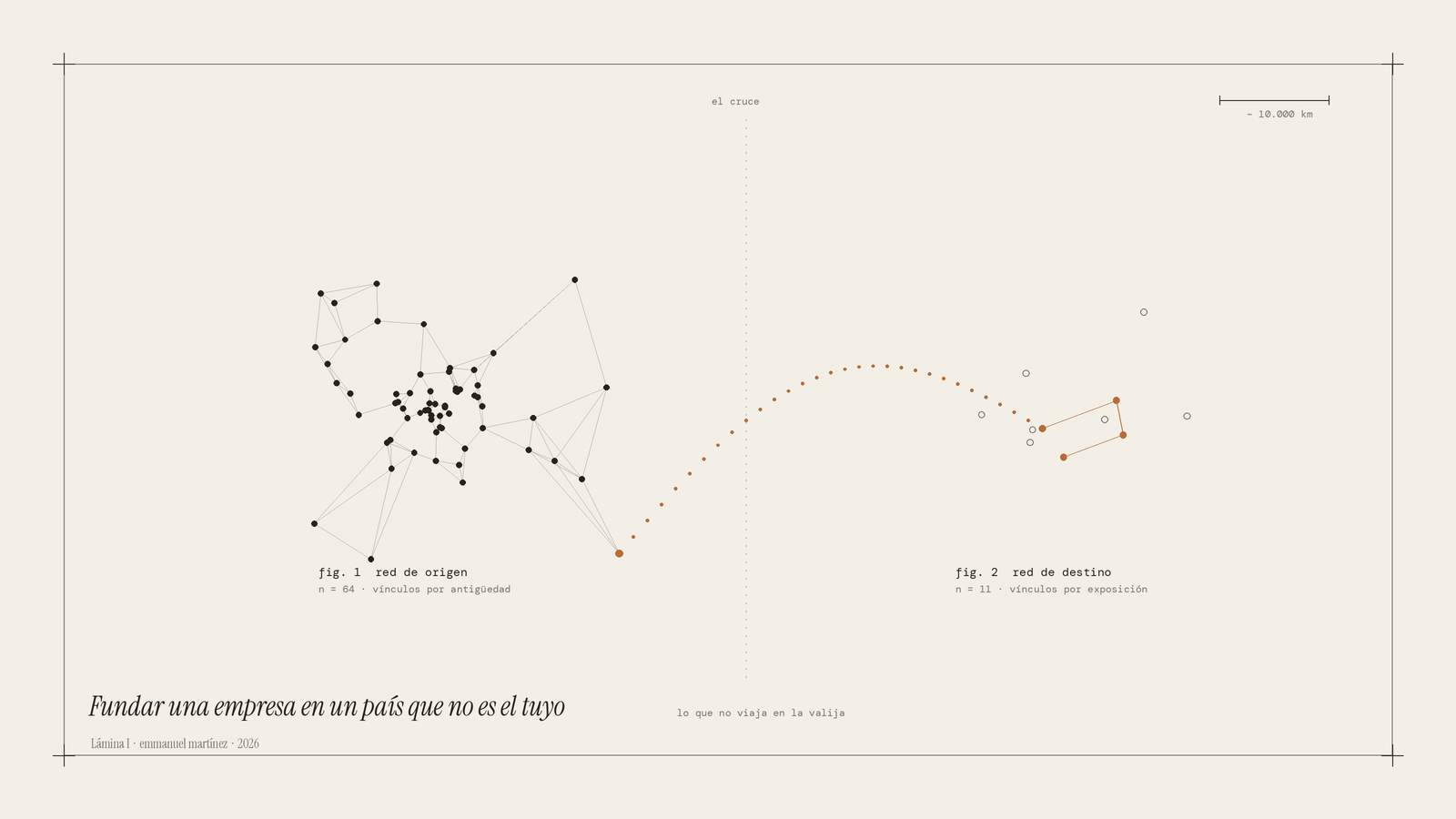
In Argentina, after fifteen years, I had a network. Not a LinkedIn network: a real one, people who picked up the phone and passed me a contact just because. Here I arrived with that worth zero. All that reputation stayed on the other side of the Atlantic and doesn't travel in your suitcase.
And when you found something, the network isn't a luxury, it's your first sales channel. A small company's first clients come from people who already knew you. If you don't have those people, you have to go out and find clients cold, which is ten times harder and slower. I knew that perfectly well and founded the company anyway, which I still don't know if it was courage or recklessness. Probably a bit of both.
What I didn't know is that the network rebuilds faster than you think when you're doing something real. Not through networking, a word that gives me hives. Through projects: you deliver well, someone mentions you, someone else shows up. It's slow, it's handmade, and it can't be sped up with events. But it happens.
Why anyway
And yet I signed.
The underlying reason is simpler than it seems: I didn't want to keep depending on the nine-to-six format. Not because it's a bad format, I worked that way for many years and learned a lot. It's because in that format someone else sets the ceiling. Your time, your priorities, and what your effort is worth are defined by someone who isn't you, and no matter how well things go for you, that equation never changes.
What I was looking for was something else. To be able to decide how I spend the day. For this month's effort to show up next year and not just on the paycheck. To build something little by little that one day is worth something on its own, even if I'm not sitting there eight hours a day.
And there's a part that's pure instinct and I can't justify it with data: I believe this works. I trust what we're building and I trust the people I'm building it with. After fifteen years doing this, you develop an intuition about which projects have room to breathe and which don't, and that intuition is sometimes wrong, but I'm not going to ignore it right when it's my turn.
Where I am today
I'm not going to close this with a moral, because I don't have one.
I'm still afraid of several of the things I listed above. I'm still juggling to make the numbers work. I haven't fully let go of steady income, and there are people who will tell you that means I didn't really take the leap. I see it differently: it means I want this to survive a bad quarter.
The only thing I know for certain is this: the day I signed, the question stopped being "do I dare?" and became "what do I do tomorrow?" And that second question, even though it sounds less epic, is answered much better.
If you're on the first one, I understand you perfectly. I was there for about three years.